

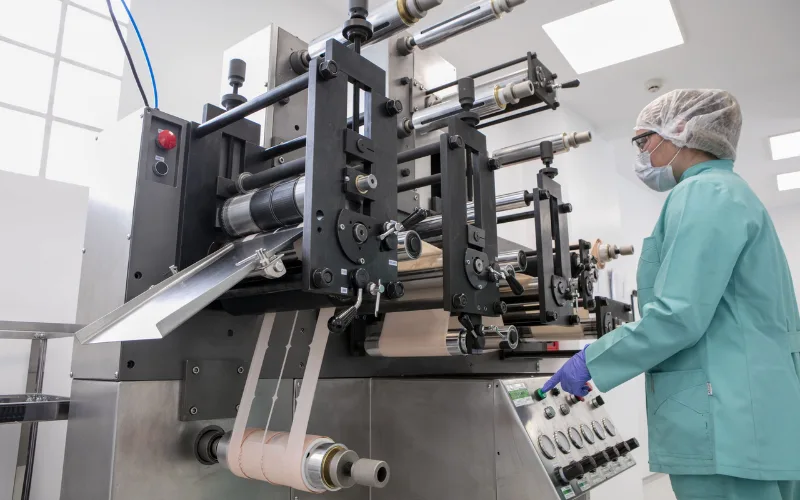
Transdermal patch production is a continuous process that demands precision at every stage and accumulated knowledge of the variables involved. It is not a process mastered quickly. Three articulated stages — mixing, coating/drying/laminating, and die-cutting/packaging — define the final outcome: a transdermal drug delivery system that is safe, effective, and reproducible batch to batch.
This article describes the manufacturing process for drug-in-adhesive (DIA) patches — the predominant design format in today’s transdermal patch market.
Stage 1 — Mixing: Homogeneity as the Foundation of Dosing Accuracy
Mixing is the starting point of the process. Its objective is to uniformly integrate all formulation components: the active pharmaceutical ingredient (API) and the functional and non-functional excipients that constitute the adhesive matrix.
The process begins with the fractionation and weighing of each material according to the established production methodology. Correct dissolution and dispersion of components at this stage is not a minor detail: the uniformity of the final mix directly determines the content uniformity of produced units — and therefore the safety and efficacy of the finished product.
In-process controls (IPCs) at this stage include visual homogeneity verification and, depending on the formulation, analytical content controls. The resulting semi-finished product is the adhesive mix, ready to proceed to the next stage.
Stage 2 — Coating, Drying, and Laminating: Building the Multilayer System
This stage transforms the adhesive mix into the laminar system that will form the basis of the patch. It comprises three consecutive sub-stages:
Coating
The adhesive mix is uniformly applied onto the release liner via a continuous coating process. Uniformity of application at this sub-stage directly determines the matrix weight per unit area — and with it, the dose delivered by each patch.
Drying
The coated assembly passes through a series of drying stations that evaporate the volatile components of the mix, converting it into the solid or semi-solid adhesive matrix with the desired properties. The temperature profile across the different drying zones is one of the critical process parameters: it affects both the adhesive properties of the matrix and the integrity of the API.
Laminating
At the exit of the drying stations, the adhesive matrix on the release liner is joined with the backing film, generating the complete multilayer system: backing film / adhesive matrix / release liner. This semi-finished laminate roll is the input to the die-cutting stage.
In-process controls at this stage include verification of adhesive matrix weight per unit area and evaluation of the laminate’s adhesive properties. Both controls are critical to ensuring that dose and adhesion are within specification.
Stage 3 — Die-Cutting and Packaging: Precision, Hermeticity, and Shelf-Life Protection
The final stage produces the patch’s definitive shape and packages it in its primary container. The shape and surface area of the patch are directly related to dose: larger area, higher drug delivery. Die-cutting performs multiple cuts on the laminate: one main cut for the patch shape and, typically, an additional cut to facilitate release liner separation before application.
Primary packaging materials (heat-sealed foil pouches) are selected based on API and excipient compatibility, required barrier properties (against moisture, oxygen, and API volatilization), and hermeticity requirements for shelf-life preservation.
In-process controls at this stage include appearance inspection (cut quality, absence of defects), hermetic seal verification of pouches, and packaging-product compatibility controls. Moisture barrier protection is particularly critical in formulations containing humidity-sensitive APIs.
Why Experience and Process Control Are the Differentiating Factor
The three stages of transdermal patch manufacturing are not independent: each formulation and process decision in one stage conditions performance in the next. Adhesive selection affects coating; drying conditions affect adhesive properties; the die shape determines final dose. Optimizing these interactions requires system-specific knowledge, adequate equipment, and accumulated experience.
It is one of the most demanding pharmaceutical processes in terms of the combination of artisanal know-how and rigorous analytical control. Choosing the right manufacturing partner, therefore, is not just a production capacity decision — it is a quality decision.
Have a transdermal patch development and manufacturing project? Talk to our production team to evaluate how we can support your program.
References
- FDA. Transdermal and Topical Drug Delivery Systems — Product Development and Quality Considerations. Draft Guidance, November 2019. https://www.fda.gov/media/132674/download
- EMA. Guideline on quality of transdermal patches. EMA/CHMP/QWP/608924/2014. October 2014.
- ICH Q8(R2). Pharmaceutical Development. August 2009.
- USP <3>. Topical and Transdermal Drug Products — Product Quality Tests. United States Pharmacopeia.