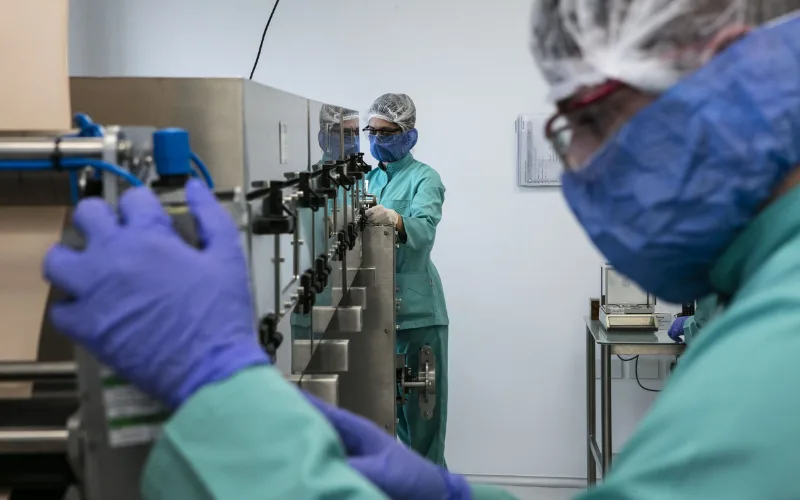
Cleaning validation in transdermal patch manufacturing is a critical GMP requirement that goes beyond routine equipment cleaning. It is the documented, systematic demonstration that an approved cleaning procedure consistently removes active pharmaceutical ingredient (API) residues — and any other contaminants — to levels that cannot compromise the safety, identity, strength, quality, or purity of subsequent products manufactured on the same equipment.
For transdermal products, the challenge is particularly acute. Campaign manufacturing, adhesive-based formulations, and the physicochemical diversity of APIs used in patches — from small lipophilic molecules to potent psychotropics — create a contamination risk profile that demands a structured, science-based validation approach.
Regulatory Framework: GMP Alignment Across Jurisdictions
Cleaning validation requirements for pharmaceutical manufacturing equipment are harmonized across the major regulatory frameworks. The FDA’s Guidance for Industry on Equipment Cleaning and the EMA’s Annex 15 on Qualification and Validation both establish the expectation that cleaning procedures must be validated through documented evidence, not merely assumed to be adequate.
Argentina’s ANMAT Resolution 3827/2018 (Buenas Prácticas de Fabricación) applies these same principles for locally manufactured products and exports: cleaning validation must be executed to ensure cleaning effectiveness, residual limits must be scientifically justified and achievable, and hold times — the intervals between production and cleaning, and between cleaning and next use — must be validated as part of the program.
For CDMOs manufacturing transdermal patches for multiple markets, aligning the cleaning validation program with the strictest applicable standard is standard practice and reduces the risk of regulatory findings during facility audits.
Establishing Acceptance Criteria and Residue Limits
The scientific rationale for residue limits must be grounded in the materials used, the therapeutic doses involved, and the toxicological profile of each API. Three approaches to limit-setting are accepted under current GMP:
- Product-specific cleaning validation: a separate acceptance criterion is established for each product-API combination. This is the most rigorous approach and is required when products differ substantially in toxicity or physicochemical properties.
- Product family grouping: products with similar APIs, formulations, or therapeutic dose ranges are grouped, and a single ‘worst-case’ product within the family is selected for validation. Successful validation of the worst case is considered representative for the entire group.
- Risk-based grouping: products are stratified by risk attributes — high solubility, high potency, difficulty of cleaning — and the worst case within each risk tier is validated. This is the most common approach in multi-product manufacturing facilities.
Regardless of the approach, the resulting acceptance criteria must meet three conditions simultaneously: they must be practical (achievable under realistic manufacturing conditions), verifiable (measurable using validated analytical methods), and scientifically defensible.
Acceptance Criteria by Testing Parameter
Step | Parameter | Acceptance Criteria |
1 | Physical determination | Equipment must be visually clean: no visible residue after cleaning procedure. |
2 | Chemical determination | The lower of: (a) NMT 0.1% of the normal therapeutic dose of any product in the maximum daily dose of the subsequent product; OR (b) NMT 10 ppm of any product in the next product. |
3 | Microbial contamination | Bacteria: <50 CFU/25 cm²Yeasts and molds: <5 CFU/25 cm² |
Worst-Case API Selection: Risk Matrix Methodology
In a multi-product transdermal manufacturing facility, selecting the worst-case API is the most consequential decision in the cleaning validation program. The worst case drives the analytical method, the sampling plan, and the acceptance limit — and it must be the most challenging API to remove from equipment surfaces under the approved cleaning procedure.
The standard approach evaluates three variables for each API present in the manufacturing environment: solubility (lower solubility = harder to remove), toxicity (lower LD50 = more critical residue), and cleaning difficulty (adhesion to equipment surfaces, reactivity with cleaning agents). An API is selected as the worst case if it scores worst on at least two of the three variables.
Example: Worst-Case API Risk Matrix
Product | API | Solubility | Toxicity (LD50) | Cleaning Difficulty | STC | Worst Case |
Product 1 | API 1 | Highly soluble | v.o: 3000 mg/kg (rat) | Intermediate | ||
API 2 | Soluble | v.o: 640 mg/kg (rat) | ||||
Product 2 | API 1 | Soluble | v.o: 760 mg/kg (mouse) | Hard | X | |
API 2 | Soluble | v.o: 640 mg/kg (rat) | X | |||
Product 3 | API 1 | Soluble | v.o: 205 mg/kg (rat) | Hard | ||
API 2 | Insoluble | v.o: 395 mg/kg (mouse) | X | X — Worst Case |
In the example above, Product 3 / API 2 is selected as the worst case: it is insoluble and presents the highest cleaning difficulty, meeting two of the three worst-case criteria.
Sampling Methods and Analytical Approaches
The two principal sampling methods accepted under GMP for cleaning validation are swabbing and rinsing. Each has specific advantages and limitations relevant to transdermal patch manufacturing:
- Swab sampling: a defined surface area (typically 25 cm²) is sampled using a validated swab material and solvent system. Swabbing can detect both soluble and insoluble residues and allows direct sampling of critical equipment surfaces, corners, and welds where residue accumulation is most likely. It requires a high level of operator training for reproducibility.
- Rinse sampling: the cleaning rinse solution is collected and analyzed. This approach is useful for equipment geometries where direct surface access is limited, but it may underestimate localized residue accumulations. Recovery from the rinse must be validated.
Analytical methods for chemical residue quantification are typically HPLC (for UV-active or derivatizable APIs) or GC (for volatile compounds and organic solvents used in transdermal formulations). Both must be validated for the specific API-surface-swab material combination. Microbiological sampling uses compendial methods (USP <1115>, EP 2.6.12-2.6.13) and requires validated sampling technique, contact time, and neutralizer where applicable.
Validation Program Design: Structure and Documentation
A compliant cleaning validation program for transdermal patch manufacturing must include, at minimum, the following elements:
- Validation Master Plan (VMP): defines scope, strategy, equipment grouping rationale, worst-case selection, and program lifecycle (including re-validation triggers such as formulation changes, equipment modifications, or cleaning procedure changes).
- Cleaning Procedure (SOP): specifies agents, concentrations, contact times, temperatures, and mechanical action. Must be written before validation begins — validation validates the procedure, not the concept.
- Analytical Method Validation: demonstrates specificity, linearity, accuracy (recovery %), precision, LOQ, and LOD for the API/surface combination.
- Sampling Plan: defines sampling points with diagrams or photographs, number of replicates per surface, sample collection method, hold time before analysis, and labeling requirements.
- Validation Report: documents the ≥3 consecutive successful replication runs, statistical analysis of recovery data, comparison against acceptance criteria, and conclusion.
Equipment grouping — applying a single validation to multiple pieces of equipment of similar design, size, and material of construction cleaned by the same procedure — reduces the validation burden without compromising rigor, provided that the worst-case unit within the group is included.
Have a formulation challenge or need to validate cleaning procedures for a transdermal manufacturing line? Talk to our development and quality team about your molecule.